A product mind and an AI-native builder, in one.
Most businesses have one thing costing them real money or time that nobody has the room to fix. We work out whether software is the answer, then build it and put it in production: an AI feature that holds up on real data, a manual process automated away, a new product or internal tool launched. Scoped and priced before we start.
If one of these is your quarter, we should talk.
Most of our work starts from one of these. If you recognize yours, the first call will be a short one.
An AI feature is on the roadmap with no path to production
The demo works. Making it reliable on real customer data, with evals and a sane failure mode, is a different job. That is the work we do.
A manual workflow is quietly capping growth
Someone spends their week on review, copy-paste, or reconciliation. That work is usually automatable, and the hours you get back compound.
Something needs shipping sooner than a hiring cycle could finish
Senior capacity in weeks instead of months, with no headcount added and nothing to unwind if the need turns out to be temporary.
An initiative is stuck between product and engineering
The decisions and the code keep waiting on each other. One person holding both ends is usually what unsticks it.
Live products, running in real businesses.
Every build below started at zero. A product, a revenue line, a practice with no presence at all. Different businesses, same job.
An AI SaaS, built end to end
Took a compliance platform from zero to production across 1,000+ US markets: the AI data engine, partner integrations, the public API, billing, and license filing. Product, design, and engineering, all of it.
Live 1,000+ US markets, in production
Stack Next.js · AI data pipeline
What that means for you. If you need AI reading messy real-world sources and being right about it, in production, with the failure modes handled, we have already built the hard version of that.
View it live →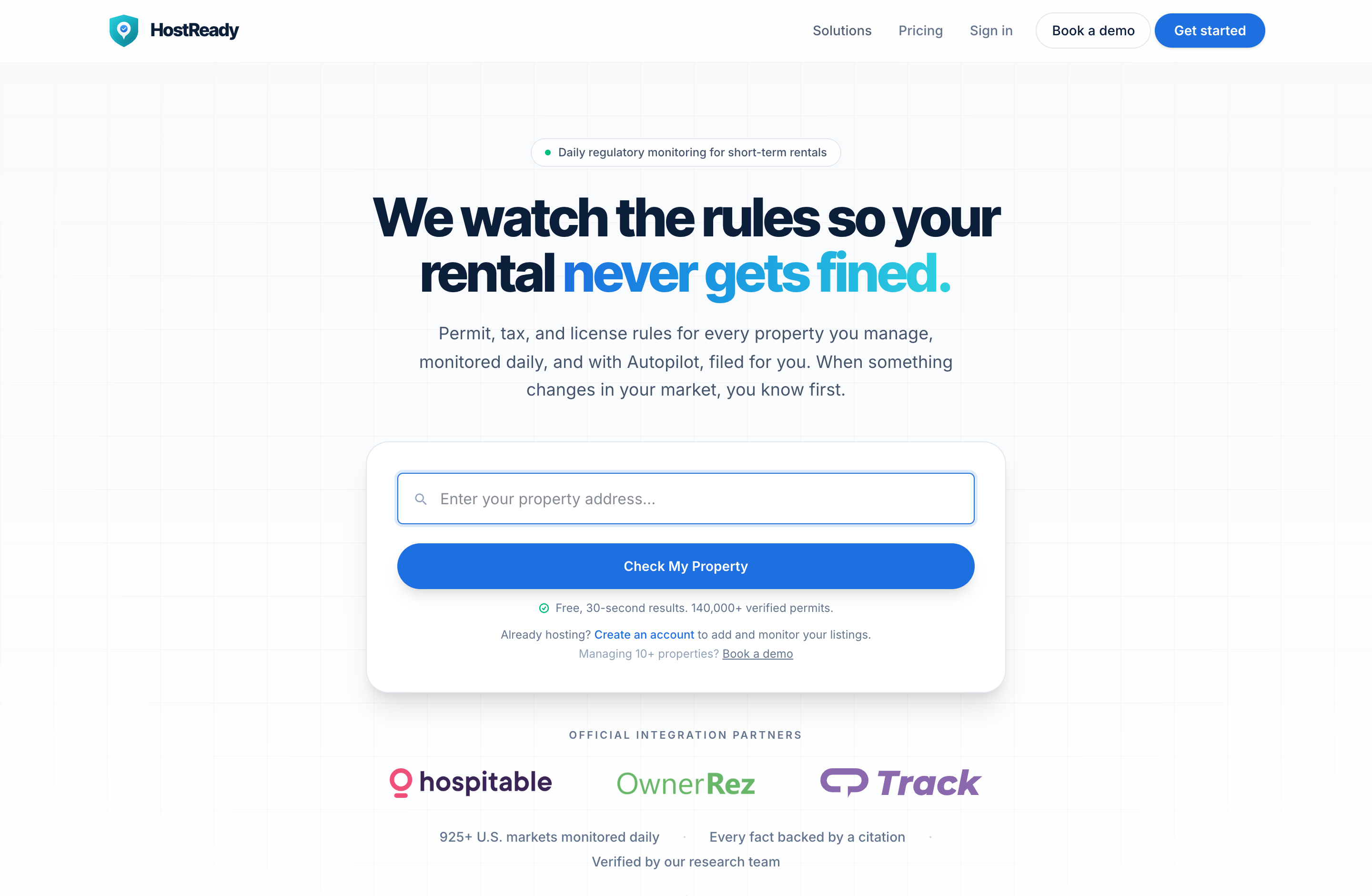
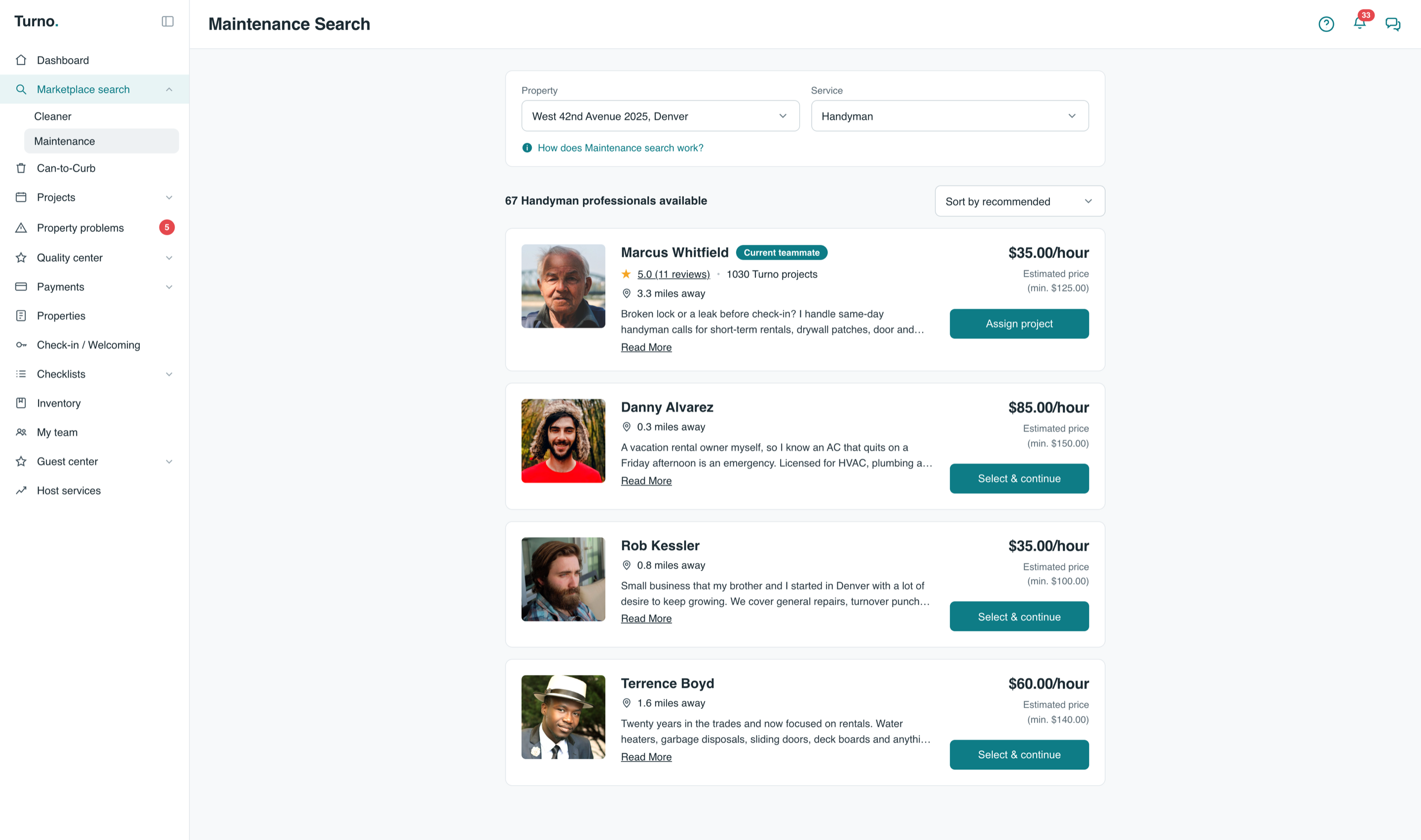
A second marketplace, launched from zero
Turno's marketplace only served cleaning. I launched maintenance as a second vertical: the service catalog, the matching, and the pricing, plus the carrier onboarding that brought supply in step with demand. An AI automation screened and routed requests, so the vertical scaled without the manual review that was slowing activation down.
Built Catalog · matching · pricing · AI routing
What that means for you. A new revenue line taken from nothing to money in a quarter, with the manual review designed out before it could become someone's full-time job.
Data products operators relied on
Built revenue-driving data products
Two practices, online for the first time
Result inbound that does not depend on a referral
Three kinds of work.
Three shapes a first version usually takes. All of them end the same way: software running in production, in your stack, tested and documented and yours to keep. We do every layer ourselves, which is why none of this needs a hand-off between the plan and the code.
AI features and workflow automation
For teams with an AI feature stuck at the demo stage, or a manual process eating real hours every week.
LLM applications, extraction and enrichment pipelines, and agents built to survive live data rather than a scripted demo. We have built extraction pipelines that read thousands of messy government and third-party sources and have to be right about every one of them.
New products and internal tools
For founders and teams who need a product, an MVP, a customer portal, or an operational tool actually launched.
Discovery through to a real launch, phased so you see something working early instead of at the end. We have taken two products from zero to live this way, one of them a new revenue line that did $31K in its first quarter.
Embedded product engineering
For teams who need a senior person to own an important initiative inside the roadmap and codebase they already have.
We work in your repo, your tools, and your rituals, and hold both ends of the problem. The people in your strategy conversation are the people who then go and write it.
Send us the problem. Get a scope and a fixed price.
You should not need a procurement department to buy a piece of software. There is no RFP, no six-month minimum, and no partner you meet once and never see again. Here is the whole path, start to finish.
A paragraph is enough. Use the brief form at the bottom of this page, or write to us directly. No form maze, and no discovery call you have to book in order to book a discovery call.
We work through what you are trying to change and whether building anything is the right answer. If we are not the right people for it, you will hear that on this call rather than after an invoice.
A written scope, the sequence we would build it in, a timeline, and a number that does not move. Small, well-understood builds get this for free. Anything large or genuinely ambiguous starts with a Scoping Sprint instead, 1 to 2 weeks at $3,500 flat, credited against the build if you go ahead and yours to keep if you do not.
In your stack, your repo, your conventions, with something working to look at every week. No big reveal at the end, and no change order the moment reality turns up.
Tested, documented, and yours to own outright. Keep us on for whatever comes next or take it from here. Both are normal, and there is no lock-in either way.
Most work is fixed scope, priced up front. Some of it is embedded, where we join your team for a sprint or a quarter and own a piece of the roadmap. A little is retained monthly. The path above is the same either way.
We will tell you honestly when a simpler tool, or no build at all, is the right call. Your outcome matters more to us than billable hours.
You talk to the people building it.
We've run the business and written the code, so we build like the outcome is ours.
Productsmith runs on one standard: the people who decide what to build are the people who build it. No account manager, no discovery team handing a spec to a bench you never meet, and no ramp-up you pay for.
Every engagement is run by someone who has carried a P&L and written the code. Ten years across AirDNA, CoStar, Expedia and Turno, a marketplace vertical launched from zero, and an AI SaaS built and shipped end to end, strategy and engineering and data pipeline alike. Which usually means the hard version of what you're trying to do has been built once already.
That background is why ambiguity is not a problem here, why the same person can hold a board conversation and a code review, and why the result gets treated the way an owner would treat it. When a build needs a specialist we don't cover, we bring in people we've shipped with before and we tell you we're doing it. If you need senior help fast without adding headcount, that's the work we take.

The things people ask before they hire us.
What does the Scoping Sprint cost, and do I always need one?
$3,500 flat for one to two weeks, and no, you often do not need one. If what you want is clear enough to scope from a call and a look at your systems, you get the scope and the fixed price for free. The sprint is for work that is large, genuinely ambiguous, or where the honest answer to "should we build this at all" is not yet obvious. If you do go ahead with the build, the fee comes off the price. If you do not, the plan is yours to take anywhere.
What size of project is a good fit?
Anything from a two-week build to a quarter of embedded work. The sweet spot is a problem one senior person can hold in their head and own end to end: an AI feature, an internal tool, a workflow that should be automated, an integration, a first version of a product. If you can describe the outcome in a paragraph, it is probably a fit.
What is not a fit?
Work that genuinely needs a team of five for a year. Pure strategy with no intention to build anything. Anything requiring a security clearance or on-site presence full time. And projects where the real problem is organizational rather than technical, because software will not fix that and we would rather say so than take the money.
Can you work in our existing codebase, alongside our engineers?
Yes, and that is the usual arrangement. We work in your repo, follow your conventions, go through your review process, and ship through your pipeline. Your engineers keep owning what they own. We are there to take one thing off the list, not to reorganize how your team works.
Who owns the code?
You do, outright, from the first commit. It lives in your repository. There is no license, no hosting you have to keep buying from us, and nothing that stops working if we stop working together.
What happens if the scope changes halfway through?
Small changes are absorbed, because a fixed price that falls apart the first time reality intervenes is not really a fixed price. Something that genuinely changes the shape of the work gets discussed openly before anyone does anything, with a revised number you can say no to. What will not happen is a surprise invoice at the end.
How quickly can you start, and how do you handle our data?
Usually within one to two weeks of agreeing a scope. On data: we work under your NDA, use the least access that lets the work happen, and prefer test or anonymized data anywhere it will do. If your business has particular constraints, raise them on the fit call and we will tell you honestly whether we can meet them.
You are small. What if the work needs a specialist you do not have?
We bring in people we have shipped with before, and we tell you we are doing it rather than quietly marking up somebody's hours. Being small is why you get senior people on your actual problem instead of a partner at the pitch and a junior for the build. Where a job genuinely needs a standing team of five, we will say that on the first call.
Tell us what you're trying to ship.
Two ways in. Book a call if you want to talk it through, or send a short brief if you'd rather not open a calendar yet. Either way you get a straight read on what it would take, whether or not we end up working together.
Book a call
We go through the problem, what you've already tried, and what shipping it would actually involve. If we are not the right fit, we will say so on the call and point you at someone who is.
Prefer to read first? Connect on LinkedIn.
Send a project brief
Goes straight to us. Nothing is shared and you won't be added to a list.